


UnReflectAnything: RGB-Only Highlight Removal by Rendering Synthetic Specular Supervision
Paper • 2512.09583 • Published • 1






UnReflectAnything inputs any RGB image and removes specular highlights, returning a clean diffuse-only outputs. We trained UnReflectAnything by synthetizing specularities and supervising in DINOv3 feature space.
UnReflectAnything works on both natural indoor and surgical/endoscopic domain data.
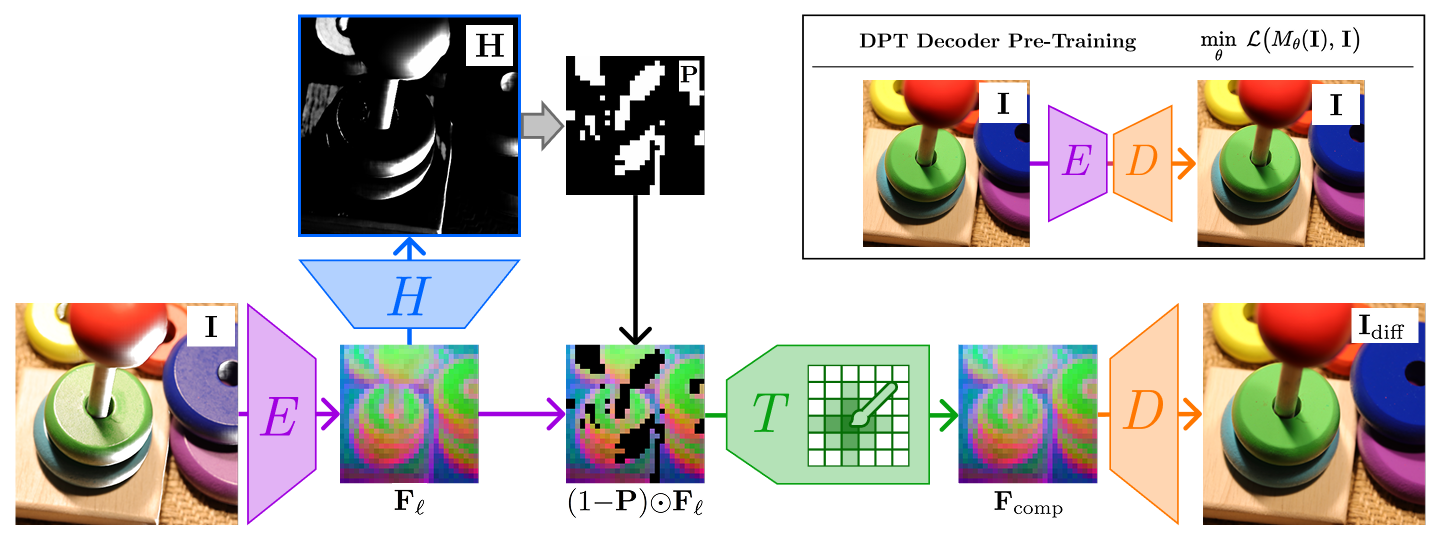
Encoder (E): Processes the input image I to extract a rich latent representation, F_l. This is the off-the-shelf pretrained DINOv3-large
Reflection Predictor (H): Predicts a soft highlight mask (H), identifying areas of specular highlights.
Masking Operation (P): A binary mask P is derived from the prediction and applied to the feature map: (1 - P) * F_l. This removes features contaminated by reflections, leaving "holes" in the data.
Token Inpainter (T): Acts as a neural in-painter. It processes the masked features and uses the surrounding clean context prior and a learned mask token to synthesize the missing information in embedding space, producing the completed feature map F_comp.
Decoder (D): Project the completed features back into the pixel space to generate the final, reflection-free image I_diff.
We train UnReflectAnything with Synthetic Specular Supervision by inferring 3D geometry from MoGe-2 and rendering highlights with a Blinn-Phong reflection model. We randomly sample the light source position in 3D space at every training iteration enhance etherogeneity.
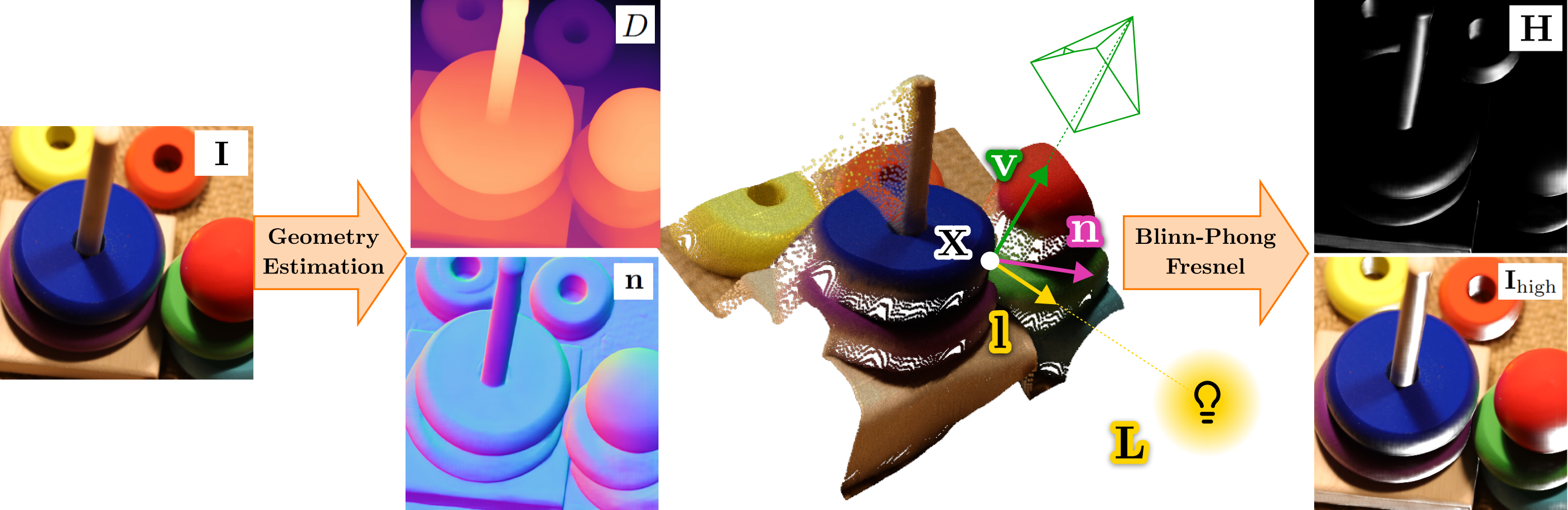
We train the model in two stages
L(M_θ(I), I)) to ensure it can reconstruct realistic RGB textures from the DINOV3 latent space.Install the API and CLI on a Python>=3.11 environment with
pip install unreflectanything
then run
unreflectanything download --weights
to download the .pth weights in the package cache dir. The cache dir is usually at .cache/unreflectanything
import unreflectanything
import torch

# Load the pretrained model (uses cached weights)
unreflect_model = unreflectanything.model()

# Run inference on a tensor [B, 3, H, W] in range [0, 1]
images = torch.rand(2, 3, 448, 448).cuda()
diffuse_output = unreflect_model(images)

# Simple file-based inference
unreflectanything.inference("input_with_highlights.png", output="diffuse_result.png")
Refer to the Wiki for all details on the API endpoints
The package provides a comprehensive command-line interface via ura, unreflect, or unreflectanything.
ura inference --input /path/to/images --output /path/to/outputura evaluate --output /path/to/results --gt /path/to/groundtruthura verify --dataset /path/to/datasetRefer to the Wiki for all details on the CLI endpoints
If you use UnReflectAnything in your research or pipeline, please cite our paper:
@InProceedings{Rota_2026_CVPR,
    author    = {Rota, Alberto and Kiray, Mert and Karaoglu, Mert Asim and Ruhkamp, Patrick and De Momi, Elena and Navab, Nassir and Busam, Benjamin},
    title     = {UnReflectAnything: RGB-Only Highlight Removal by Rendering Synthetic Specular Supervision},
    booktitle = {Proceedings of the IEEE/CVF Conference on Computer Vision and Pattern Recognition (CVPR)},
    month     = {June},
    year      = {2026},
    pages     = {241-250}
}